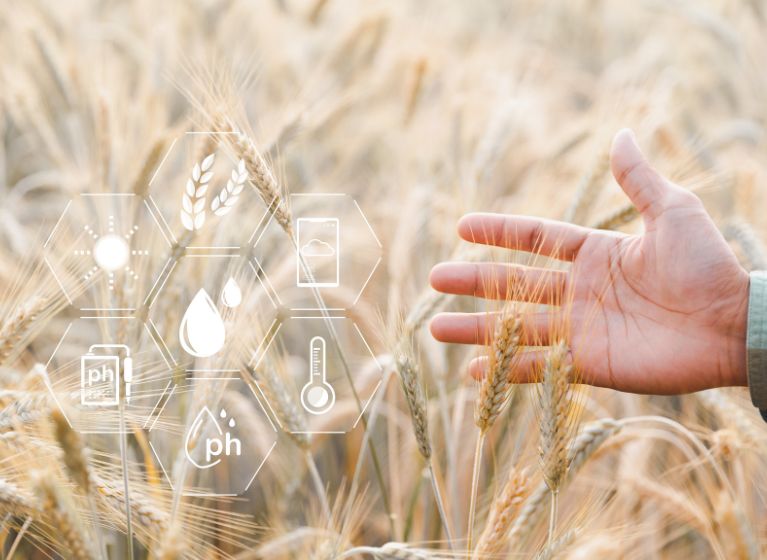


Digital agriculture encompasses a wide range of data-processing techniques and automated control systems for improving the efficiency, productivity and sustainability of agricultural activity.
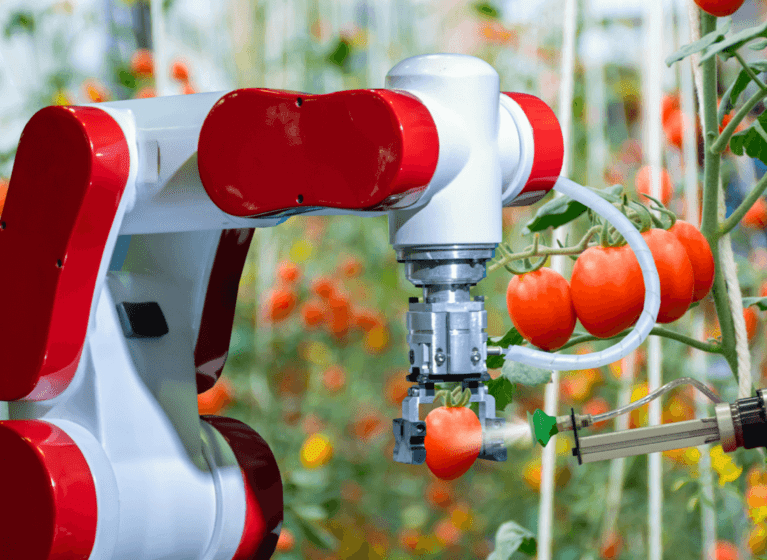
Digital twins and artificial intelligence (AI) are powerful tools, but software alone does not plant seeds or pick fruit. Robots and automated apparatus are the end effectors of digital agriculture providing the connection between digital systems and physical agricultural operations.
Agricultural robotics in Australia
Australia has established capabilities in digital agriculture and robotics, supported by university research, a robust and growing start-up ecosystem and an agricultural sector with a strong interest in productivity-enhancing technologies.
Just recently, Robotics: Science and Systems 2026 was held in Sydney and opened with a keynote by Professor Salah Sukkarieh, an expert in agricultural robotics.1 Australia’s agricultural sector is substantial, with gross production forecast at almost $100 billion for 2026–27 and around three-quarters of that expected to be exported.2
Australia is not only a research base but a major export-driven market that increasingly implements robotics platforms and automation to boost productivity in light of its population, labour supply, land mass and climate. Altogether, this makes Australia well placed to both develop and benefit from agricultural automation and robotics, which makes local protection all the more important.
Robotics in the field of agriculture
Agricultural robotics spans applications in:
- Field and crop operations: autonomous ground vehicles, drones, swarm platforms and remotely operated vehicles for planting, de-weeding, watering, fertilising, monitoring, and harvesting crops.
- Post-harvest processing: automated cutting, trimming and portioning lines, computer vision grading, sorting and packaging, and material handling.
- Livestock and aquaculture: robotic systems for pest-detection and deterrence, and autonomous feeding, monitoring, herding, cleaning and protection of animals.
- Data acquisition hardware: distributed sensors and automated sampling probes, cameras and scanners on autonomous platforms, and localisation and mapping systems.
- Precision end effectors: soft or compliant grippers for harvesting without damaging plants, yield or stock, and specialised tooling for de-weeding, animal handling and crop processing.
- Perception, control, support and enabling systems: autonomous docking and charging stations, geo-fencing, valves, actuators, transceivers, and agriculture-specific hardware to assist in the deployment of robotics systems more broadly.
Innovations may arise in the complete robotic platform or in the individual parts of the system. These can involve, for example, new mechanical devices, sensing and imaging modules, monitoring and control processes, end effectors, and navigation systems, as well as the interaction between software logic and physical components.
By way of just one example, multiple-arm robotic systems in controlled environments such as hydroponic greenhouses use live data synchronisation to achieve incredibly high accuracy in delicate tasks of plant husbandry across the full cycle from seeding to harvesting.
Protecting robotics innovation
Many agricultural robotics innovations warrant IP protection, in particular protection by way of patents.
Patent protection is territorial. In general, a granted patent in a given country provides the exclusive right to make, hire, sell, use, exploit or otherwise perform the invention in that country.
Modern robotic systems may operate across several jurisdictions. For example, a robot may collect data in one country, use cloud-based processing located elsewhere and then perform a physical task in the field. This makes the location and scope of the relevant activities important considerations when developing a patent filing and claim strategy.
The concrete, physical nature of a robotic system generally supports patentable subject matter eligibility, in contrast with the difficulties that can be encountered with some other areas of technology.
As readers may know, patents for pure software inventions can face challenges as being seen to involve purely abstract ideas using generic computers. However, improvements which provide particular new functionalities in the physical realm may well obviate such potential obstacles. The specific requirements vary between different countries and there are some grey areas.
Relevant to AgTech, Australia’s 1959 High Court Decision “NRDC” established that inventions which provide an artificially created state of affairs (in that case a weed-free tract of land) with a material advantage and a useful physical result in relation to a material or tangible entity are eligible for patent protection in Australia.3
Accordingly, inventions in automation and robotics generally represent such practical results, with concrete, tangible or observable effects, which supports patentable subject matter eligibility both in Australia and in other jurisdictions.
Final thoughts
The value of digital agriculture is ultimately realised in the physical world, and robotics is what carries software across that divide. This physical dimension can be relevant to both the scope of protection and the patentability of an invention in this sector.
For those innovating in robotics, automation or other digital agriculture technologies, it is worth considering how and where the technology produces its practical effect. Patent protection may be available for advances across the hardware, software, sensing and control systems that enable that result. Considering the IP position early and with expert advice can help align the protection strategy with the technology’s likely development and commercial use.
Here at FPA Patent Attorneys, we have deep knowledge and experience in these technologies (as well as in engineering and robotics more generally and other areas of agricultural technology such as biochemistry, plant varieties and agrichemicals). If you are interested in protecting your innovations in this space, please get in touch with our Agribusiness team.
1 https://roboticsconference.org/program/keynotes-spotlights/
2 https://www.agriculture.gov.au/abares/research-topics/agricultural-outlook/june-2026#daff-page-main
3 National Research Development Corporation v. Commissioner of Patents [1959] HCA 67 at 13, 20, 22 and 25.