

A decade of international PCT publications reveals who is racing to recycle the world’s batteries, and how one company pursues national protection along the mineral supply chain
Every battery that powers an electric vehicle (EV) or a grid-storage plant will one day reach the end of its life, and inside it sits valuable metals such as nickel, cobalt, lithium and manganese. As the first generation of batteries begins to retire, recovering those metals has become a fast-moving frontier in clean technology. In Part 1 of this article series on battery technologies, we charted the rise of China across battery patenting generally. Here we turn to the recycling of those batteries, a field that is not only growing faster than the battery field as a whole, but, as we show below, is dominated by one company pursuing a revealing patent strategy of its own.
As before, we consider PCT (international) patent application publications. A PCT filing is a deliberate signal of intent to seek protection beyond the home market. That lens matters here as, by our estimate, roughly 95% of Chinese battery-recycling patent families are filed only in China and never abroad. Those domestic filings are far from worthless as they confer potential competitive advantage inside China’s vast home market. However, they signal no intention to seek protection internationally. PCT applications, therefore, strip out the home-market layer and reveal who is genuinely contesting the world’s battery recycling IP landscape.
A field growing twice as fast as the battery boom
Battery-recycling PCT publications rose from 43 in 2016-17 to a peak of 542 in 2024-2025, representing an increase of roughly 13-fold, or an annualized increase of about 32% year on year. That is twice the ~15% annual growth of the broader battery field over the same decade. This places recycling as one of the most dynamic corners of the entire battery patent landscape.
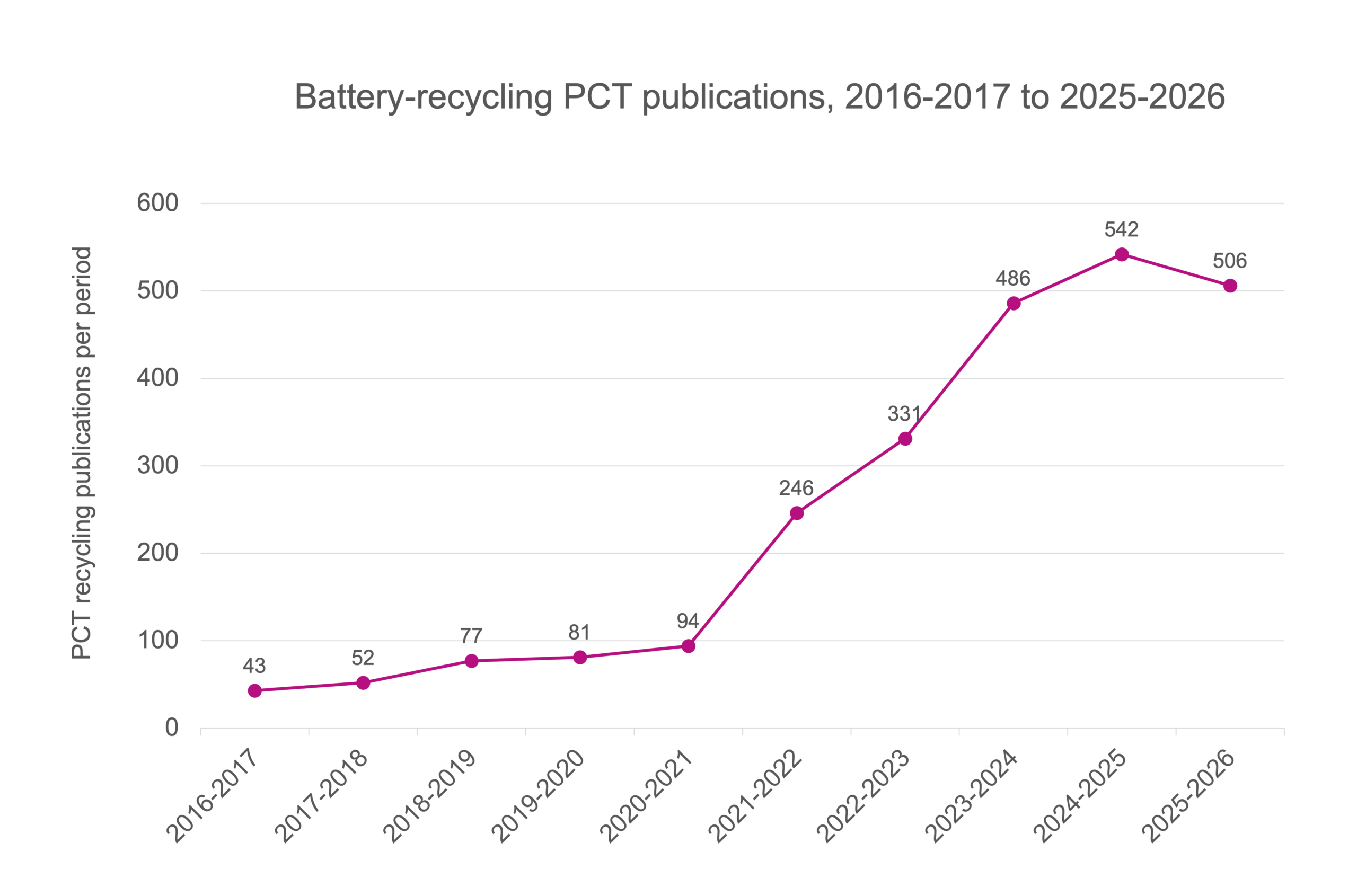
Each data point is a complete twelve-month period of published applications, so the counts are directly comparable end to end. As a PCT application publishes around eighteen months after filing, published application trends are a lagging reflection of filing decisions taken earlier. Even at its peak, recycling still represents only about 4% of all battery patenting, a fast-growing but still-emerging niche.
A more balanced map than battery patenting generally
Measured by the applicant’s country of residence, recycling is far less China-dominated than battery patenting generally. China leads (24% of publications), but Korea, Japan and the United States follow closely, resulting in a much flatter distribution than the ~38% Chinese share seen for all-battery PCT publications discussed in Part 1 of our series.
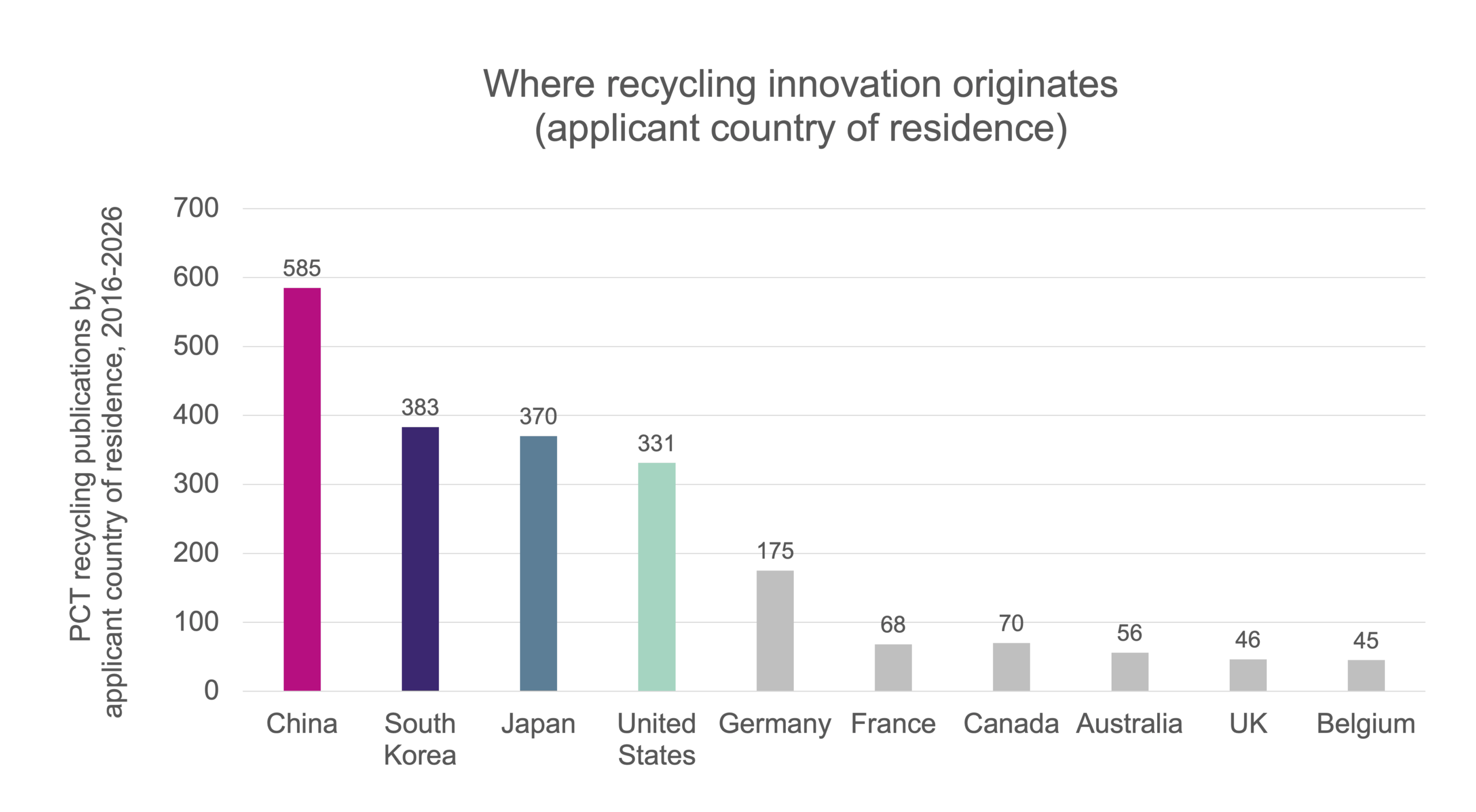
Two contrasts from the all-battery data discussed in Part 1 of this article series stand out. The United States is stronger in recycling than its declining position in battery patenting overall, reflected in pure-play recyclers such as Ascend Elements, Redwood Materials and Li-Cycle. And Japan has a stronger presence in recycling than its diluted position in battery patenting overall would suggest, propelled by its metals and chemical refiners rather than its battery-makers.
Who owns the recycling frontier?
A decade’s cumulative league table (consolidating affiliated entities) is dominated by a single name. CATL’s Brunp group leads with 348 PCT publications, more than the next four applicants combined, and around 60% of all Chinese-applicant PCT recycling filings. However, Brunp’s dominance does not mean the rest of the field is a simple two-player contest against a single rival. It is genuinely multi-bloc.
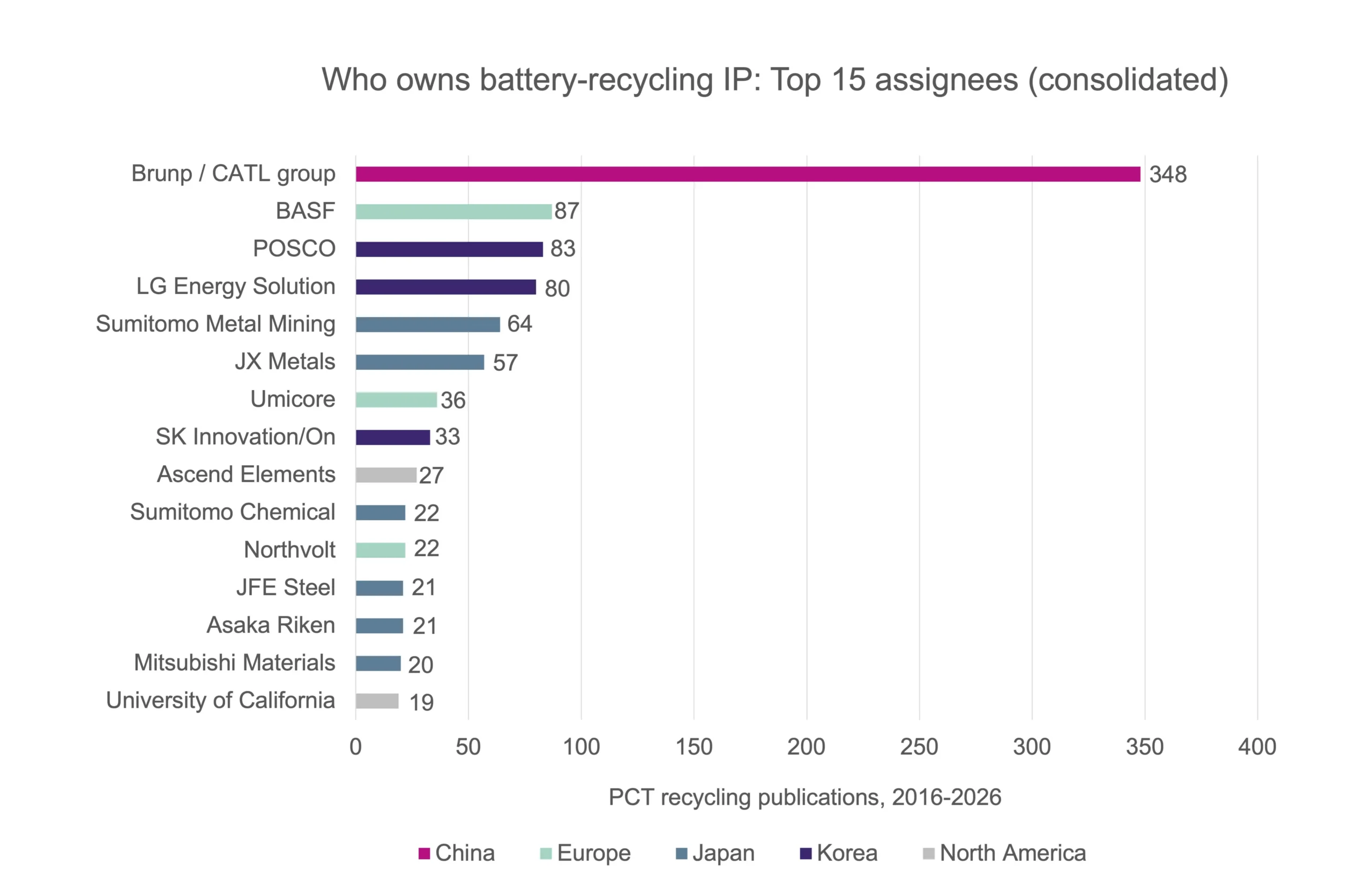
In contrast to battery-makers (where China dominates), Japan has the most players in relation to battery recycling, with six in the top fifteen. This is led by its metals and refining incumbents (Sumitomo Metal Mining, JX Metals, Mitsubishi Materials, Asaka Riken, Sumitomo Chemical, JFE Steel). These companies are largely absent from the broader battery-patent leaderboard.
Europe’s contribution splits in two: established industrial-chemistry players BASF (at number two) and Umicore; and Northvolt, the Swedish battery manufacturer that diversified into recycling before its 2024–2025 bankruptcy. Korea’s battery-makers (POSCO, LG, SK) and, from the United States, the start-up Ascend Elements alongside the University of California, complete a far more contested field than battery patenting generally.
A leaderboard that shifts over time
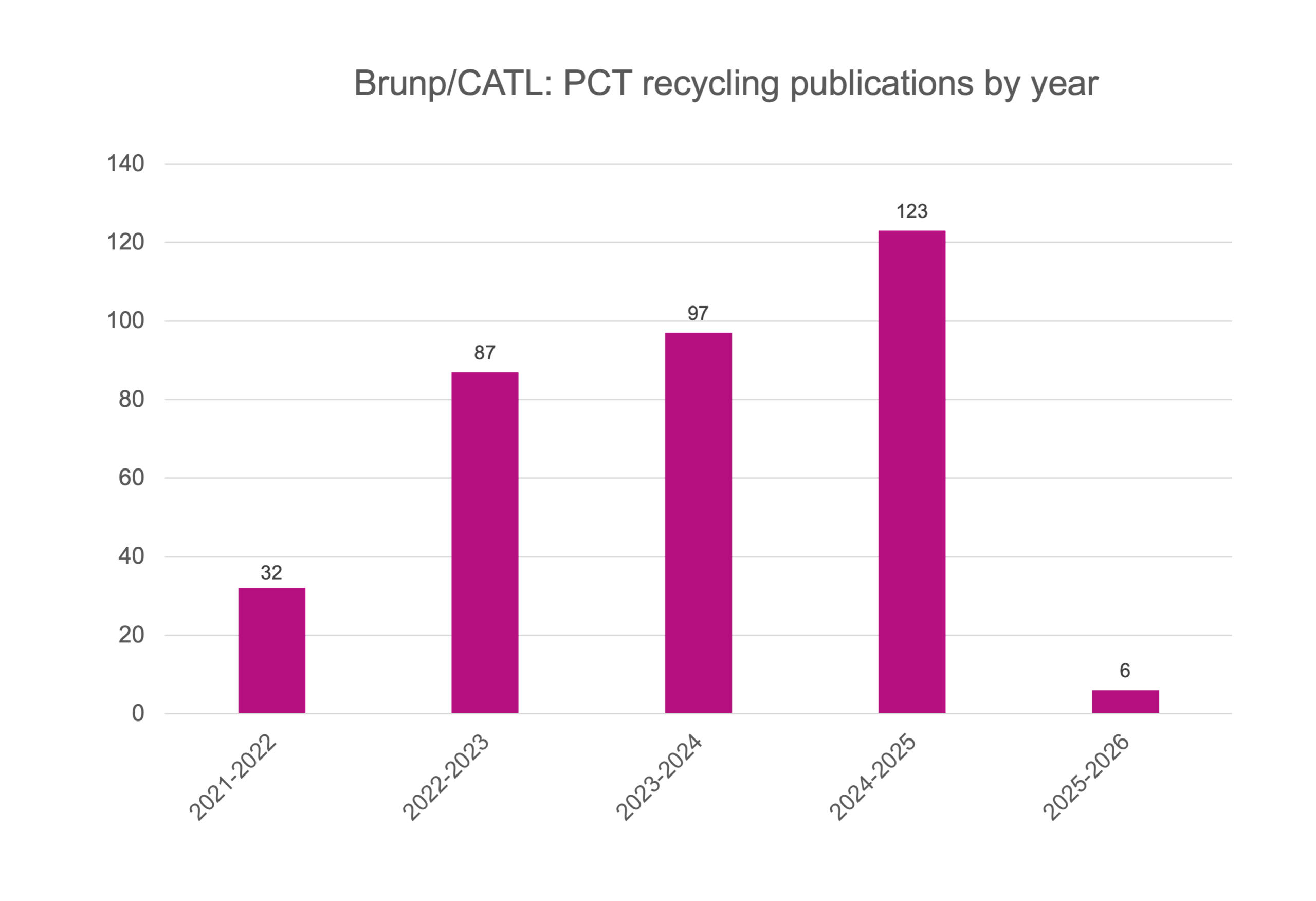
Tracking each applicant year by year exposes a dynamic the cumulative table conceals. Brunp’s own trajectory is the most dramatic: its PCT recycling publications climbed steadily from 32 in 2021-2022 to a peak of 123 in 2024-2025, before falling away sharply to just 6 in 2025-2026. As the discussion of ultimate filing destinations below makes clear, this recent fall reflects a swing in where Brunp seeks protection rather than a collapse in its underlying patent activity.
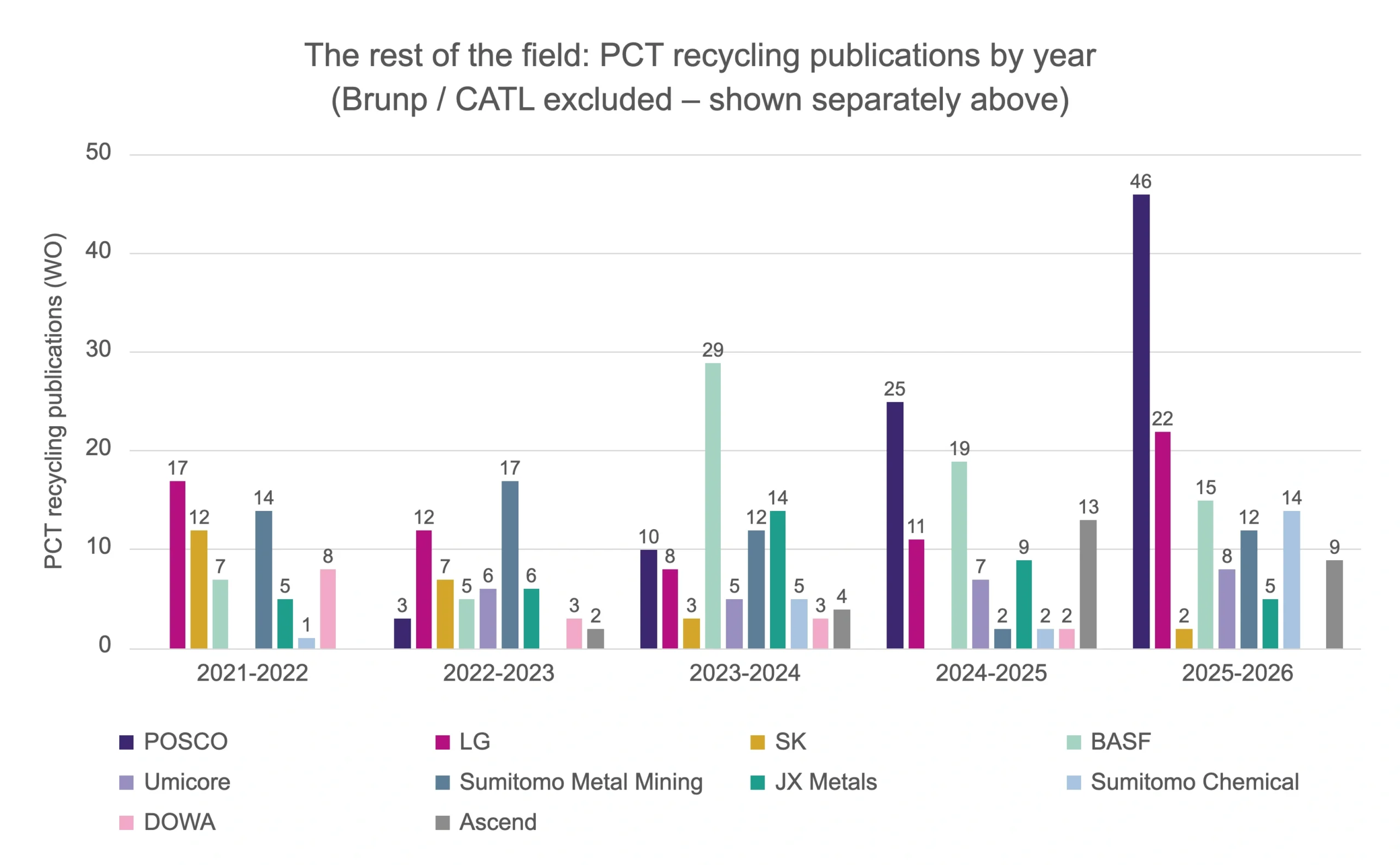
Set Brunp aside, and the rest of the field is genuinely dynamic. POSCO is the clearest riser, growing in every year of the series to lead the field outside Brunp by 2025-2026, while BASF shows an uneven but strong pattern built around a single burst of activity in 2023-2024. The Korean and Japanese incumbents remain steady presences, and a tail of smaller entrants have built modest positions in the most recent years.
The overall effect is a more internationalised and contested battery recycling patent frontier. Brunp remains the largest cumulative filer by a wide margin, but the data shows Korean, Japanese, European and US applicants occupying far more of the field around it.
Brunp’s own filing behaviour also shows a striking shift in where it seeks protection. Its PCT publications rose steadily relative to its domestic Chinese filings between 2020-21 and 2024-2025, from a small fraction of its output to near parity (123 PCT publications against 128 domestic Chinese filings in 2024-2025). In the most recent year, however, PCT publications fell sharply to just 6, even as its domestic Chinese filing reached its highest level yet (218), a reversal not evident in the prior four years. Whether we will see an increase in Brunp’s recycling PCT publications in the future remains to be seen.
The headline: One company patents where the minerals are and files differently to get there
Given how much of this field one company occupies, it is worth asking not only where Brunp ultimately seeks international protection, but how it gets there. Both answers are precise, and together they tell a more interesting story than either alone.
Why Brunp files where it does
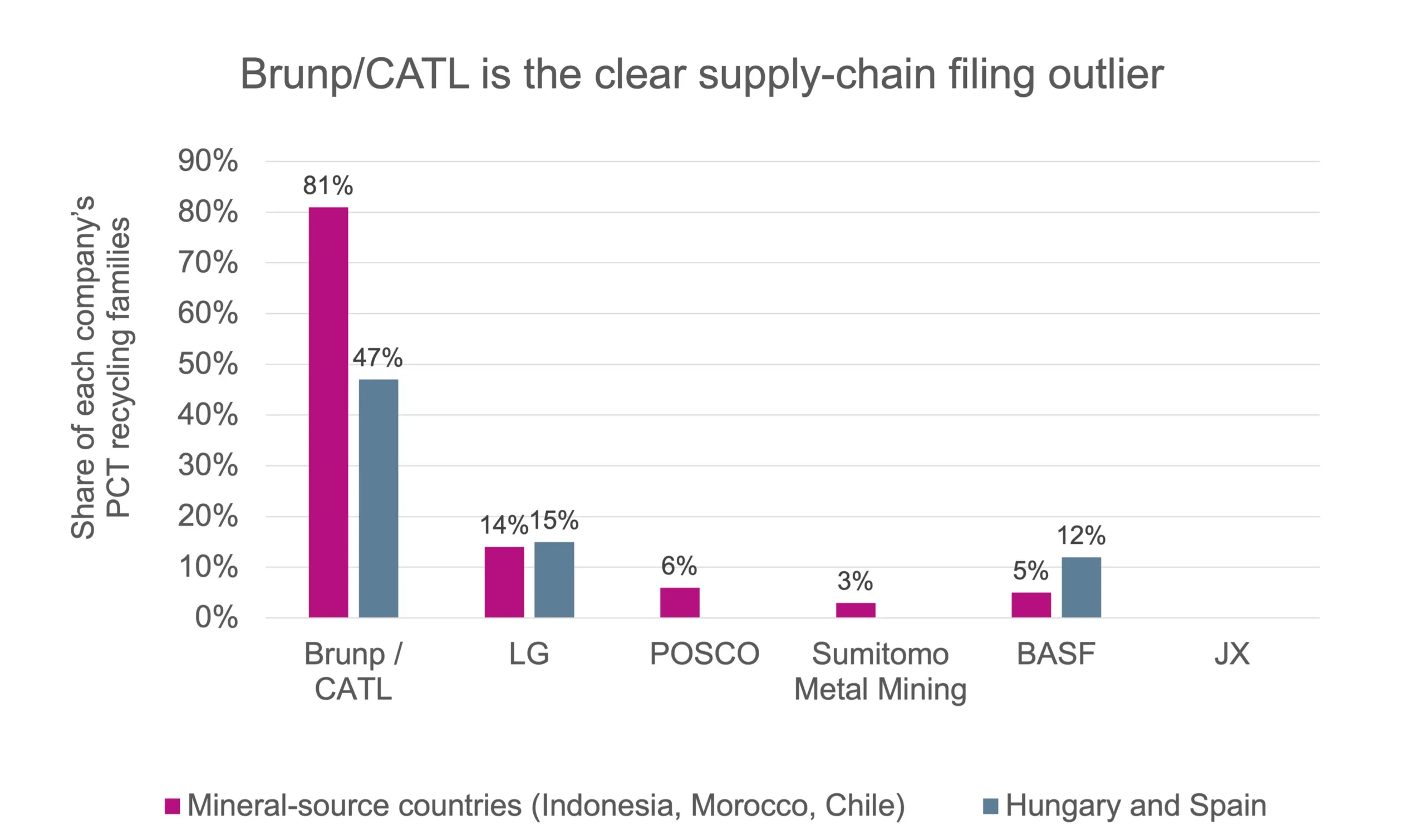
Alongside the established commercial markets, Brunp files heavily in countries that map directly onto CATL’s mineral-processing and manufacturing footprint. The clearest signal is Indonesia, the source of more than 60% of the world’s mined nickel1. It appears as a filing destination in 57% of Brunp’s decade of PCT families, and is Brunp’s single most common foreign destination, ahead of the United States. Morocco, with its unusually large phosphate reserves2 and emerging battery-materials industry, is another standout, and Chile provides a smaller lithium-linked signal. Across Indonesia, Morocco and Chile together, approximately four in five Brunp families reach at least one mineral-source country.
This pattern is overwhelmingly Brunp’s own. Indonesia appears as a destination in 14% of LG’s PCT families, 6% of POSCO’s, 5% of BASF’s, 3% of Sumitomo Metal Mining’s, and it was absent from the JX set reviewed. The other leading portfolios remain principally distributed across the conventional markets of China, Europe, Japan, Korea, the United States and Canada.3
The geographic alignment also has an operational counterpart. In Indonesia, Brunp-linked CBL is a partner in CATL’s nearly US$6 billion integrated project spanning nickel mining and processing, battery materials, battery manufacturing and battery recycling4. These activities provide a plausible commercial context for Brunp’s filing choices.
The route Brunp chooses: Speed over optionality
Where Brunp seeks protection is only half the story. How quickly it gets there is another interesting aspect. Brunp files a PCT application for most of its recycling families, so on paper it looks like every other applicant in this field. Yet across its core mineral-source and manufacturing destinations, it often files national applications ahead of standard deadlines, rather than waiting out the full PCT timetable. In Indonesia specifically, filings are already in place well before the standard international timeline allows.
The European angle
The same filing pattern extends to Europe. Brunp’s German, Spanish and Hungarian filings are, overwhelmingly, direct national applications rather than validations of a granted European patent, and Hungary or Spain is chosen as a direct filing destination in almost half of Brunp’s families.
Appreciating that this is speculation on our part, several strategic considerations may explain this choice. Where an applicant already knows precisely which countries it wishes to protect, as a company patenting its own manufacturing and mineral-processing footprint plausibly would, much of the rationale for the European route falls away. Direct national filing avoids the cost of an overarching European application, sidesteps the risk of a single centralised European Patent Office (EPO) opposition capable of revoking protection across all designated states at once, and is not exposed to the variable examination timeframes at the EPO. The direct route is, in that light, less a quirk than a signal of a firm, pre-formed view of exactly where protection was wanted.
In Europe as in Indonesia, this operational picture has a commercial counterpart. CATL has its Debrecen battery-cell project in Hungary and, with Stellantis, a new LFP gigafactory project in Zaragoza, Spain5.
Contrast with the other players
The five other leading recyclers typically do the opposite. Each of LG, POSCO, BASF, Sumitomo Metal Mining and JX internationalises through the PCT and, for Europe, through the EPO: their national protection takes the form of validated European patents. The pattern of early national filing and EPO bypass that characterises Brunp is not generally observed among them.
Filing timing is itself a signal of intent. Committing to national protection early, often ahead of the deadlines a standard PCT timetable follows, means deciding sooner, and paying sooner, for exactly which countries matter to an applicant. The data showing that Brunp secures protection early and directly in Indonesia, Morocco and its European manufacturing states, rather than waiting out the standard timetable, is consistent with a company protecting a physical footprint it has already built or is building. Brunp’s competitors, filing PCT applications but nationalising them on the standard international and European timetable, look by contrast like companies filing on the industry’s default timetable, rather than accelerating protection. Figure 5 is therefore best read not simply as a map of where these companies file, but as a map of where one of them has decided, ahead of the field, that it needs patent protection.
What it means
- Recycling is booming. PCT filings grew ~32% a year over the decade, about twice the pace of the battery field, though still a ~4% niche of all battery patenting.
- A more balanced field than battery patenting generally. China leads recycling filings, but by a much smaller margin than in the battery sector overall, with Korea, Japan and the US close behind.
- One company, not one country, explains the minerals pattern. Indonesia is Brunp’s single most common foreign destination (57% of its PCT families), compared with 14% for LG, 6% for POSCO, 5% for BASF, 3% for Sumitomo Metal Mining and none in the JX set reviewed. Morocco reinforces the supply-chain signal and Hungary and Spain are operational supporting examples.
- A multi-bloc contest beneath Brunp. Japan’s refiners, Europe’s chemical majors, Korea’s battery-makers and US start-ups make the rest of the field far more contested, and less China dominated, than battery patenting generally.
- Timing and route matter as much as destination. Brunp reaches many of its target countries with national protection in place unusually early, often ahead of standard deadlines, rather than waiting out the full PCT timetable, and it typically bypasses the European Patent Office, filing national applications directly in its European markets instead. The other leading recyclers internationalise the conventional way, entering national phase on the standard timetable and validating through the EPO in Europe. This difference in speed and route, not just in destination, is the more striking finding.
Methodology notes. Figures are PCT applications published in the battery-recycling space, identified through a hybrid classification-and-keyword search (core codes Y02W 30/84 and H01M 10/54, plus keyword-gated metallurgy classes C22B, C01G and C01D), batteries-only, over complete August-to-August periods from 1 August 2016 to 1 August 2026. Assignee figures consolidate affiliated entities, including the Brunp/CATL group and LG (Energy Solution and Chem). Domestic-only families are excluded because they do not signal overseas protection. The company-by-company destination comparison is based on PCT family sets and complete family-jurisdiction lists.
National-phase members continue to appear over time, so recent families do not yet show their full country coverage. Two effects are at work. First, the most recent PCT publications have not yet reached the 30 or 31 month deadline for national-phase entry, so no national filing decision has yet been made. Second, even once that deadline has passed, national offices vary considerably in how quickly they publish an entered application, so a family can show no foreign member for a further time period after entry, purely as a matter of publication timing. This does not affect the PCT publication counts themselves, which are complete once published; it affects only the national-phase country-coverage figures, which should be read as a conservative, current-day floor, expected to rise for any given priority cohort as time passes. European national counts are additionally affected by filing route: direct PCT national entries appear earlier, whereas national validations following an EP filing appear only after grant. In comparing companies, Indonesia and Morocco are therefore cleaner destination comparisons than Hungary and Spain.
Search validation. The completeness of this corpus was stress-tested rather than assumed. The classification-and-keyword search was benchmarked against the full published PCT portfolios of known major recyclers (for example, the entire ten-year output of CATL’s Brunp group and of pure-play recyclers such as Ace Green Recycling), confirming that the core classification net (Y02W 30/84 and H01M 10/54) captures effectively all of their internationally filed recycling activity. A supplementary all-applicant sweep of adjacent water-treatment and adsorbent classes (C02F and B01J 20), gated to end-of-life battery language, was also run to probe for records sitting outside the core codes; it surfaced only a handful of additional genuinely relevant families across the entire decade, an immaterial fraction of the corpus that does not affect any figure or conclusion in this article. A related scope point emerged from that exercise and is worth mentioning: “recycling” in a battery patent title does not always mean end-of-life battery recycling. Some applicants, Brunp in particular, also file heavily on the in-process recovery of materials generated during virgin cathode manufacturing, which is a distinct activity and is deliberately excluded from the figures here. Investment and reserve or production figures are drawn from the sources given below.
Sources:
1 Indonesia accounted for an estimated 62% of global mined-nickel production in 2024 (USGS); more recent 2025 estimates from the International Nickel Study Group and industry sources put the figure at approximately 65–67%. Source: USGS, “Indonesia”, National Minerals Information Center
2 Morocco holds an estimated 50 billion metric tons of phosphate rock reserves, representing approximately 68% of world reserves (USGS); other sources place the figure at up to ~71%. Source: USGS, “Morocco”, National Minerals Information Center
3 Company-by-company review of PCT recycling family sets and complete family jurisdiction lists. Indonesia appeared in 57% of Brunp/CATL families, 14% of LG families, 6% of POSCO families, 5% of BASF families, 3% of Sumitomo Metal Mining families and none of the JX families reviewed. Across Indonesia, Morocco and Chile, approximately 81% of Brunp/CATL families reached at least one mineral-source jurisdiction.
4 CATL states that its Indonesia Battery Integration Project, involving Brunp-linked CBL (Ningbo Contemporary Brunp Lygend) and Indonesian partners ANTAM and Indonesia Battery Corporation, spans nickel mining and processing, battery materials, battery manufacturing and battery recycling, with planned investment of nearly US$6 billion. Source: CATL, “Indonesia Battery Integration Project”
5 CATL’s Debrecen project is described as a €7.34 billion battery-cell investment in Hungary, the largest single greenfield investment in Hungary’s history. CATL and Stellantis broke ground in November 2025 on a lithium iron phosphate gigafactory in Zaragoza, Spain, with capacity of up to 50 GWh. Sources: CATL, “CATL Officially Kicks Off European Battery Manufacturing Base in Hungary”; CATL, “CATL, Stellantis break ground on battery plant in Spain”