


The Australian Government’s Australia’s Economic Accelerator (AEA) has announced the recipients of round 1 of the “Innovate” grants.1 This article aims to provide insights to the grants awarded and the technology areas that appear to be hot topics for innovation in Australia.
What are the Innovate grants?
The Innovate stage funding is the second of two active AEA funding pathways intended to help bridge the gap between initial research and commercialisation. The first stage (referred to as the “Ignite” stage) is aimed at laying the foundations of the commercialisation bridge and leads into the Innovate stage which aims to complete the crossing.
The Innovate grants are designed to “support mid-stage research commercialisation through competitive grants of up to $5 million for a maximum period of 24 months.” 2 The grants are targeted at university institutions who are ready to progress a project beyond lab proof of concept.3
Importantly, to be awarded an Innovate grant, the recipient organisation needs to show a level of industry engagement that demonstrates an appetite for commercialisation.
The grants awarded
The awarded grants amount to a total of just over AU$93 million across 39 projects which are to be run at various university institutions across Australia. The grants range from about AU$500 thousand to just under $5 million, the latter being the limit that can be awarded under the Innovate programme.
The funded projects are aligned with the AEA’s “Focus Areas” of:
- quantum computing
- artificial intelligence (AI)
- advanced manufacturing
- critical and strategic minerals processing
- digital agriculture
- sustainable fuels.4
These Focus Areas fall within the Australian Government’s “Priority Areas” of:
- value-add in resources
- agriculture, forestry & fisheries
- medical science
- renewables & low emission tech
- defence capability
- enabling capabilities.5,6
Transport was the only Priority Area to miss out on this round of funding.
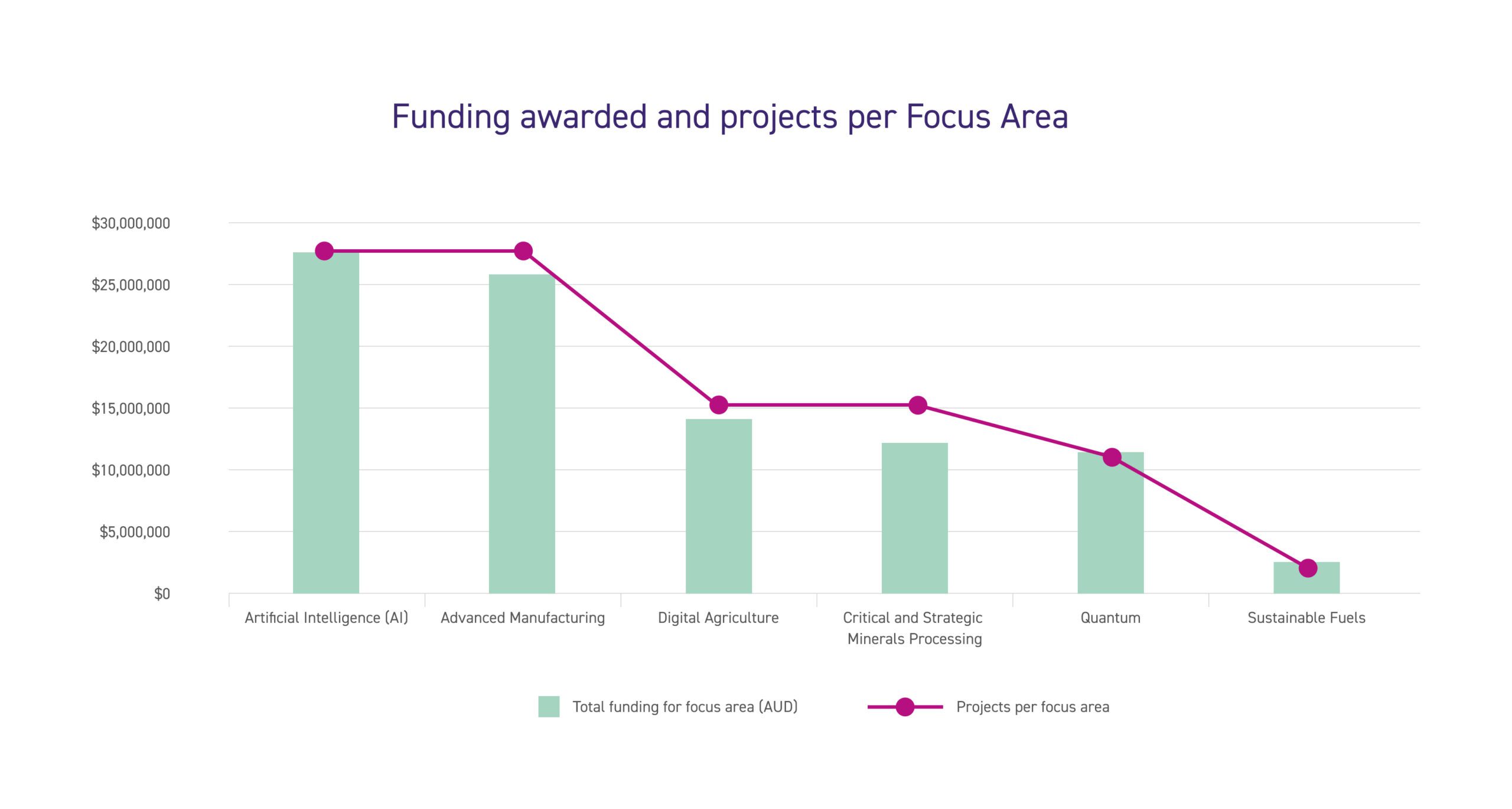
As can be seen in the below chart, there is a significant allocation of funding in the Focus Areas of AI (AU$27.7 million) and Advanced Manufacturing (AU$25.3 million). These two Focus Areas account for well over half of the total grants awarded in this round and each also account for 11 of the 39 funded projects.
Focus Areas and Priority Areas
Indicative of the broad ranging applications of “AI” and “Advanced Manufacturing”, the projects relating to these two Focus Areas span across multiple Priority Areas. Projects funded for other Focus Areas also extend across different Priority Areas but to a lesser extent.
The below chart maps out how the Focus Areas and the Priority Areas overlap for the funded projects, and the number of projects that fall within each overlap.
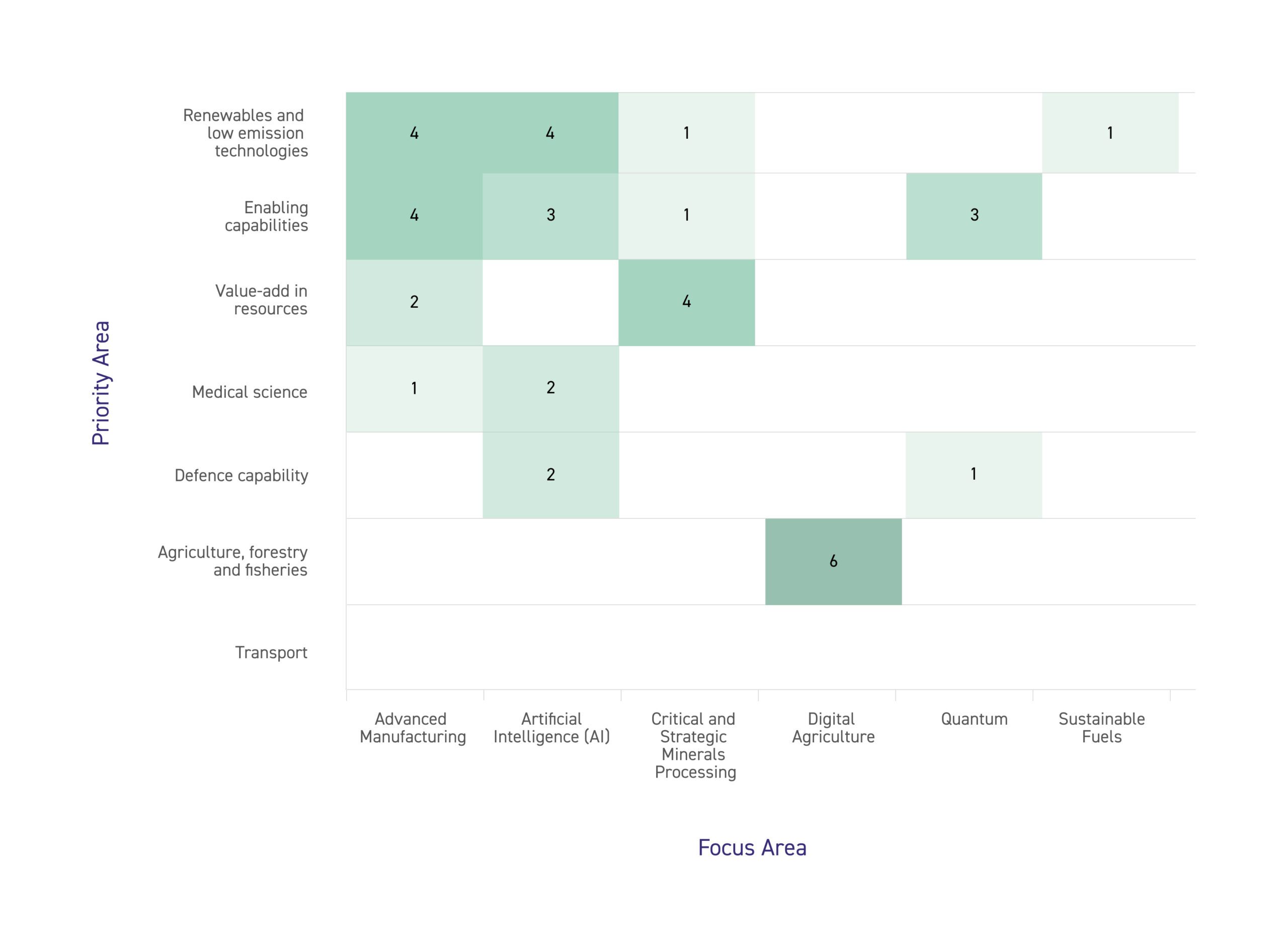
This chart reveals a correlation between the Focus Areas of “AI” and “Advanced Manufacturing” and the Priority Areas of “Renewables and low emission technologies”. This suggests that the Australian Government is taking steps to bolster Australia’s green tech credentials and achieve Australia’s climate goals.7
There is also a correlation between the “AI” and “Advanced Manufacturing” Focus Areas with the rather cryptically named “Enabling Capabilities” Priority Area, which includes “manufacturing technologies and products that support the advancement of Australia’s industrial capability”. 8
However, the overlap with the largest number of projects is between the Focus Area of “Digital Agriculture” and the Priority Area of “Agriculture, forestry and fisheries”. This is perhaps reflective of the significance that agriculture has in the Australian economy, particularly in food exports9, and the rapid innovation occurring in AgTech.10
Another notable overlap is seen in the Focus Area of “Critical and strategic minerals processing” and the Priority Area of “Value-add in resources”. This may be unsurprising given Australia’s natural resources and the importance of those natural resources to Australia’s economy.11
Innovation by the (patent filing) numbers
The “Australian IP Report 2025”12 published by IP Australia provides some further insights to the trending technology areas in terms of Australia patent application filings. The report groups Australian patent applications together using technology groups according to a scheme maintained by the World Intellectual Property Organisation.13
Interestingly, none of the AEA Focus Areas directly correlate to the top 5 technology groups, which include Pharmaceuticals, Medical Technology, Biotechnology, Organic Fine Chemistry, and Civil Engineering.14
Correlations can instead be drawn between the trends in “strong” and “weak” growth technologies and the associated Focus and Priority areas.
For example, the Focus Area of AI (11 funded projects) falls within the technology group of Computer Technology which was a weak growth area according to the report. Computer Technology does not appear to include Quantum Computing which is instead treated separately. Driving funding in AI might be an attempt to reverse the stagnant growth of computer related applications, particularly in filings by local applicants. The recent softening of how patentable subject matter provisions are applied under Australian law may also assist in creating an uptick of applications.15
Additionally, the Critical and Strategic Minerals Processing Focus Area broadly aligns with the technology group of Materials Metallurgy which is a strong growth technology, albeit with only a 2.4% share of all patent applications in 2024 (trending up year on year from 1.4% in 2021). Again, this aligns with the importance of natural resources to the Australian economy.
There is also a notable correlation between Priority area of ‘Renewables and low emission technologies’ (10 grants across 4 focus areas) and the technology group of Transport. Patent filings under the transport technology group are up from a 2.8% share in 2021 to a 3.5% share of all patent applications in 2024. The Transport area is growing strongly, at least in part, due to filings by Chinese based applicants relating to EV’s16, 17. The governments prioritising of Renewables and low emission technologies is on trend with this rise of the EV.
The increase in the filing numbers for Materials Metallurgy and Transport is notable as it bucks the overall trend for patent applications in Australia which have declined in recent years from a peak of 32,409 in 2021 to 30,478 in 2024. However, this overall decline is consistent with, and may be in part caused by, the decline in the filings for two of the top 5 technology groups: Pharmaceuticals, and Medical Technology.
From the above, it would appear that the correlations discussed point to a strategy of promoting the traditional powerhouses of the Australian economy while also encouraging innovation in areas that promote advancement in greener technologies, and in areas that take advantage of the rapid development of AI. Only time will tell if this strategy accelerates the economy as intended.
At FPA Patent Attorneys, we help innovators protect and commercialise their ideas across all areas of technology including emerging technology areas. If you’d like to discuss how insights such as those discussed in this article could impact you, get in touch.
1 https://www.dcceew.gov.au/climate-change/emissions-reduction/net-zero
2 https://www.nrf.gov.au/what-we-do/our-priority-areas/enabling-capabilities
3 https://www.rba.gov.au/education/resources/snapshots/economy-composition-snapshot/
4 https://www.fpapatents.com/news-insights/insights/pixel-perfect-pastures-patents-in-computer-implemented-agriculture/
5 https://www.rba.gov.au/education/resources/snapshots/economy-composition-snapshot/
6 https://www.ipaustralia.gov.au/tools-and-research/professional-resources/data-research-and-reports/Australian-IP-Report-2025
7 https://www.wipo.int/meetings/en/doc_details.jsp?doc_id=117672
8 https://www.ipaustralia.gov.au/tools-and-research/professional-resources/data-research-and-reports/Australian-IP-Report-2025/Chapter-2-Patents/Technology-Fields
9 https://www.fpapatents.com/news-insights/insights/aristocrat-v-commissioner-of-patents-whats-the-practical-guidance/
10 https://www.ipaustralia.gov.au/tools-and-research/professional-resources/data-research-and-reports/Australian-IP-Report-2025/Chapter-2-Patents/Technology-Fields
11 https://www.fpapatents.com/news-insights/insights/ip-australias-filing-numbers-show-evs-innovation-on-the-rise/
12 https://www.ipaustralia.gov.au/tools-and-research/professional-resources/data-research-and-reports/Australian-IP-Report-2025
13 https://www.wipo.int/meetings/en/doc_details.jsp?doc_id=117672
14 https://www.ipaustralia.gov.au/tools-and-research/professional-resources/data-research-and-reports/Australian-IP-Report-2025/Chapter-2-Patents/Technology-Fields
15 https://www.fpapatents.com/news-insights/insights/aristocrat-v-commissioner-of-patents-whats-the-practical-guidance/
16 https://www.ipaustralia.gov.au/tools-and-research/professional-resources/data-research-and-reports/Australian-IP-Report-2025/Chapter-2-Patents/Technology-Fields
17 https://www.fpapatents.com/news-insights/insights/ip-australias-filing-numbers-show-evs-innovation-on-the-rise/