

Part 3 of the Battery IP Insights series: a concise map of the major rechargeable chemistries, their trade-offs, leading players and commercial maturity, ahead of a companion analysis of where the patents are being filed.
Every battery is a compromise. No single chemistry is simultaneously the most energy-dense, the cheapest, the safest, the longest-lived and the most abundant in raw materials. Improve one of these metrics and another usually gives up ground.
The art of battery engineering, and of choosing a battery chemistry for a given product, is deciding which of those trade-offs matter most. A long-range electric vehicle (EV) and a grid-storage plant are not solving the same problem, and they increasingly do not use the same chemistry.
This article maps the modern rechargeable battery field, setting aside the legacy lead-acid and nickel chemistries, and groups it into three families: the lithium-ion incumbents that dominate today; the next-generation cell chemistries chasing higher energy or lower cost; and the stationary battery specialists built for the grid. Part 4 of our series will then examine where each of these areas sits in the patent landscape.
The lithium-ion family: One framework, many flavours
“Lithium-ion” is not one chemistry but a family, distinguished mainly by the cathode material (and, in one case, the anode). All share the same “rocking-chair” mechanism, shuttling lithium ions between electrodes. The anode is almost always graphite (carbon), increasingly blended with a small amount of silicon to raise capacity. Silicon is emerging as an anode material in its own right, and blended into or partly replacing graphite, it can push cell energy toward roughly 350 Wh/kg1. Although, the drawback of increasing silicon content is that the anode swells substantially on charging, so for now it remains a partial rather than wholesale substitution. However, it is the cathode that predominantly varies from one chemistry to the next, and the cathode that sets battery energy density, cost, safety and lifetime. Every one of these cathodes also contains lithium, which the shorthand names below do not always make obvious.
LCO (lithium cobalt oxide), paired with a graphite anode, launched the commercial era of lithium-ion batteries with Sony in 1991. Its high energy density still suits phones and laptops, but high cobalt loading and poor thermal stability have pushed it out of applications like automotives or stationary storage due to the larger number of cells required. LMO (lithium manganese oxide), also paired with graphite, is cheaper and safer but lower in energy and lifetime, and today mostly appears blended with other cathode materials.
NMC (lithium nickel manganese cobalt oxide, LiNiMnCoO2) and NCA (lithium nickel cobalt aluminium oxide, LiNiCoAlO2), both paired with graphite or silicon-graphite anodes, are the high-energy workhorses of premium and long-range EVs. Raising the nickel content lifts energy density but reduces thermal stability, and both carry exposure to cobalt and nickel supply chains. These are the mainstays of LG Energy Solution, Samsung SDI, SK On and Panasonic (whose NCA cells power much of Tesla’s range), with CATL also a major NMC producer2.
LFP (lithium iron phosphate), again paired with a graphite anode, gives up gravimetric energy density but offers outstanding safety (critical self-heating, the point of no return, at approximately 230 to 260°C for LFP versus approximately 170 to 190°C for NMC3), very long cycle life and the lowest cost per kWh of any lithium battery chemistry, with no cobalt or nickel. Cell-to-pack designs such as BYD’s Blade and CATL’s Qilin have clawed back much of the range gap, and LFP now dominates standard-range EVs and stationary storage. It is the core of CATL, BYD and EVE.
LTO (lithium titanate) is the exception that swaps the anode rather than the cathode: it replaces graphite with a lithium titanate anode. That sacrifices energy density but delivers extraordinary cycle life (tens of thousands of charge-discharge cycles), ultra-fast charging and wide-temperature operation, a niche fit for fast-charge buses, grid-frequency support and cold climates, led by Toshiba’s SCiB and China’s Yinlong4.
The manganese middle path
Between the low-cost LFP camp and the high-energy nickel camp, a family of manganese-rich cathodes is opening up a middle path, trading a little of each to reduce reliance on scarce, expensive nickel and cobalt. Two distinct approaches are emerging.
LMFP (lithium manganese iron phosphate) adds manganese to the LFP cathode, lifting cell voltage and energy density while keeping LFP’s safety, long life and freedom from nickel and cobalt, at only a small cost premium. Gotion’s Astroinno cell claims about 240 Wh/kg5, and CATL’s M3P variant has been validated with Tesla and is already used in Chinese-market models. The main technical hurdle is manganese dissolving out of the cathode at high temperature6.
LMR (lithium manganese-rich) takes a layered-oxide route instead, using a cathode of roughly two-thirds manganese and one-third nickel with virtually no cobalt. General Motors and LG Energy Solution plan to be first to market, with US production of LMR prismatic cells targeted for 2028. They claim LMR cells achieve around a third more energy density than LFP at comparable cost, enough for a 400-mile electric truck, and GM has built a $900 million cell-development centre in Michigan to manufacture them7.
The next-generation cell chemistries
Sodium-ion batteries are touted as the near-term disruptor to the current lithium-ion technologies. Sodium-ion batteries typically rely on the same mechanism as lithium-ion batteries, but using abundant, cheap materials, with no lithium, cobalt, nickel or copper. They also offer better cold-weather performance and safety, at the cost of lower energy density. 2025 to 2026 appears to be a commercial inflection point for sodium-ion batteries: CATL’s Naxtra cells reach about 175 Wh/kg8, the first mass-production sodium-ion passenger car (a CATL and Changan collaboration) is arriving in 2026, with mass cell production slated for the end of the year, and the first gigawatt-hours are already shipping into stationary storage9. HiNa, BYD and Faradion (now part of Reliance) are also scaling. Sodium-ion is aimed at entry-level EVs, two-wheelers and grid storage, not long-range vehicles. Two economic caveats temper the cost story. Sodium-ion needs a hard-carbon anode rather than graphite, and hard carbon is currently more expensive than the graphite used in lithium cells1; but because sodium does not alloy with aluminium, sodium cells can use cheap, light aluminium current collectors on both electrodes1, whereas lithium needs heavier, more expensive copper on the anode side10.
Solid-state batteries are the long-promised leap in energy density. Replacing the flammable liquid electrolyte with a solid conductor removes the main fire risk and, crucially, enables a lithium-metal anode, roughly doubling energy density (claims of 400 to 500 Wh/kg) with faster charging. The barrier is manufacturing rather than the chemistry: the challenges are production yield, an estimated 5 to 10 times cost premium as of mid-2026, and durable solid-solid interfaces. Toyota and Samsung SDI are running pilot lines; QuantumScape (with Volkswagen’s PowerCo) has reported multi-layer cells passing 1,000 cycles in 2024 testing11. More recent disclosures through 2026 have focused on energy density and manufacturing scale-up rather than cycle life, with no updated figure published since. Realistic volume is projected to sit in premium vehicles around 2027 to 2028, with manufacture and deployment scaling toward 203012, 13, 14.
In practice, the best measured cells today sit closer to 300 Wh/kg (QuantumScape’s most recent disclosed cell, QSE-5, reaches 301 Wh/kg, 844 Wh/L)15 than to the 400 to 500 Wh/kg the technology ultimately promises. A subtler point is that a solid electrolyte suppresses lithium dendrites (a common problem with lithium-ion batteries that ultimately cause the battery to cease functioning) through interface stability, not merely mechanical stiffness. Dendrites can still creep along grain boundaries, so a hard electrolyte alone is no guarantee against them, but suppression is still valued to improve the battery lifetime. Developers are pursuing several solid-electrolyte families, chiefly sulfides, oxides and, more recently, halides, each trading off conductivity, stability and manufacturability.
A second US developer, Factorial Energy, is pursuing a polymer-based electrolyte rather than QuantumScape’s ceramic one. Its FEST cells, validated with Stellantis and tested by Mercedes-Benz, reach about 375 Wh/kg, and in mid-2026 became the first solid-state cells to be road-tested in a Stellantis vehicle16. Encouragingly for manufacturing, real production progress is now visible as QuantumScape integrated its scalable Cobra separator process into baseline production in 2025 and inaugurated a pilot production line in early 202617. A note of caution is nonetheless warranted. The field has a long history of overclaiming, from cells later found to be conventional lithium-ion to repeatedly slipping timelines, so independently validated results deserve more weight than headline specifications18.
Lithium-sulfur batteries offer a very high theoretical energy density using cheap, abundant sulfur and no nickel, cobalt or graphite, attractive for weight-critical and applications requiring secure supply chains. Its Achilles heel is the “polysulfide shuttle” that limits cycle life. Cells are already shipping into niches such as drones, defence and space (Lyten, which has absorbed former Northvolt assets) 19, with Zeta Energy and Theion also active. However, EV-grade cycle life remains some years out20.
Lithium-air batteries have the highest theoretical energy density of all these chemistries, approaching that of gasoline, but is the least mature commercially. Laboratory prototypes (for example at Argonne National Laboratory) have reached around 1,200 Wh/kg over roughly 1,000 cycles21, and CATL has publicly flagged it as a long-horizon direction, but practical deployment, if it comes, is a post-2030 prospect22.
The stationary specialists: Built for the grid
For multi-hour and long-duration grid storage, the priorities invert. Gravimetric energy density barely matters when the battery sits in a field. In these applications, what counts is cost per cycle over decades, safety at scale and the ability to decouple power from energy. Three non-lithium families are built around exactly this.
Vanadium redox flow batteries (VRFB) store energy in liquid electrolyte held in tanks, so power (stack size) and energy (tank volume) scale independently, ideal for long durations. The electrolyte does not degrade, giving 20-to-25-year lifetimes and well over 10,000 cycles with a non-flammable, aqueous chemistry23. Upfront capital cost is high, but lifecycle economics are strong for long-duration use, and the technology has just crossed the gigawatt-hour threshold: Rongke Power’s 200 MW / 1,000 MWh Jimusar project in Xinjiang, the world’s first GWh-scale flow battery, entered operation at the end of 202524, alongside players such as Invinity and Sumitomo Electric25.
Zinc-based battery chemistries, led by zinc-bromine, target the same long-duration niche with abundant materials, an aqueous non-flammable design and no need for active cooling. The US manufacturer Eos Energy is the flag-bearer, scaling zinc-bromine systems for three to 11-hour applications with federal backing26.
Iron-air batteries push furthest into multi-day storage. It works by “reversible rusting”, oxidising and reducing cheap iron in an aqueous electrolyte, using three of the most abundant materials on Earth: iron, water and air. Round-trip efficiency is low (around 50%)27, and it is far too heavy and slow for vehicles, but the materials are so cheap that it targets roughly 100-hour durations at a fraction of lithium-ion cost. The US company Form Energy is the clear leader, with its first commercial projects and a West Virginia factory now coming online28 and iron-air is the youngest of the grid chemistries but potentially the cheapest for very long durations.
The materials question: Chemistry is also geopolitics
Choosing a battery chemistry is not only an engineering decision, but also a supply-chain and geopolitical one. Each chemistry relies on a different basket of raw materials, and those baskets are unevenly distributed. Nickel and cobalt concentrate the risk in a handful of (often unstable) countries; LFP and sodium-ion largely sidestep it; and manganese-rich cathodes are attractive partly because manganese is cheap and widely available. But one material sits under almost every lithium-ion cell regardless of cathode: graphite, the anode, and the single largest component by weight. China mines roughly three-quarters of the world’s natural graphite and processes an estimated 85 to 90% of the battery-grade material29.
That concentration became a live issue in late 2025, when China placed lithium batteries above 300 Wh/kg, cathode materials and artificial graphite anode materials under export-licensing controls, before suspending the measure the day before it was due to take effect, for one year through November 2026, as part of a wider trade understanding30. This episode underlines how tightly the chemistry map and the minerals map are now intertwined, a theme this series has explored in the context of recycling, and one that helps explain why so much of the battery industry is racing toward chemistries that need less of the contested materials in the first place.
How they compare
The table below summarises the major metrics across the fifteen core chemistries. The figures are indicative, cell-level industry data for 2024 to 2026. The real numbers vary by manufacturer and by pack design, and the emerging chemistries in particular are moving quickly. The Relative cost column tracks broadly with underlying pack-level pricing. LFP and NMC packs averaged $81/kWh and $128/kWh respectively in late 2025, a volume-weighted average of $108/kWh31.
| Chemistry | Energy density (Wh/kg, cell) | Cycle life (to 80%) | Relative cost | Safety | Primary application | Maturity |
|---|---|---|---|---|---|---|
| LCO | 150 to 200 | 500 to 1,000 | High (cobalt) | Poor | Consumer electronics | Mature, declining |
| LMO | 100 to 150 | 300 to 700 | Low | Moderate | Power tools, blends | Mature, niche |
| NMC | 150 to 290 | 1,500 to 3,000 | Medium to high | Moderate | Long-range / premium EV | Mass market |
| NCA | 200 to 260 | 1,000 to 1,500 | High | Moderate | Premium EV, tools | Mass market |
| LFP | 160 to 200 | 4,000 to 10,000 | Low | Excellent | Standard-range EV, BESS | Mass market |
| LMFP | 200 to 240 | 3,000 to 4,000 | Low | Excellent | Standard-range EV | Early commercial / scaling |
| LMR | 210 to 270 | Not yet disclosed32 | Comparable to LFP | Moderate | Electric truck, large SUV (future) | Pilot / pre-commercial |
| LTO* | 50 to 80 | 15,000 to 20,000+ | Very high | Excellent | Fast-charge, extreme temp | Commercial niche |
| Sodium-ion | 120 to 175 | 4,000 to 8,000 | Low | Excellent | Entry EV, BESS | Early commercial / scaling |
| Solid-state | 400 to 500 | 1,000 to 2,000+ | 5 to 10x (today) | High | Premium EV (future) | Pilot / pre-commercial |
| Lithium-sulfur | 250 to 400 | Low (improving) | Low materials | Moderate | Aviation, drones, defence | Early / niche commercial |
| Lithium-air | 1,000 to 1,200 (lab) | ~1,000 (lab) | Low materials | Unproven | None yet | Research |
| Vanadium flow | 15 to 25 (system) | 10,000 to 20,000+ | High capex | Excellent | Long-duration grid | Commercial (LDES) |
| Zinc-bromine | 60 to 85 | 6,000 | Competitive | Excellent | Long-duration grid | Early commercial |
| Iron-air | ~20 to 25 (system) | Thousands | Very low (iron) | Excellent | Multi-day grid | Pilot / early commercial |
* LTO denotes an anode material (paired with various cathodes); the figures reflect a typical LTO cell. Grid chemistries are shown at system level, where low gravimetric density is by design.
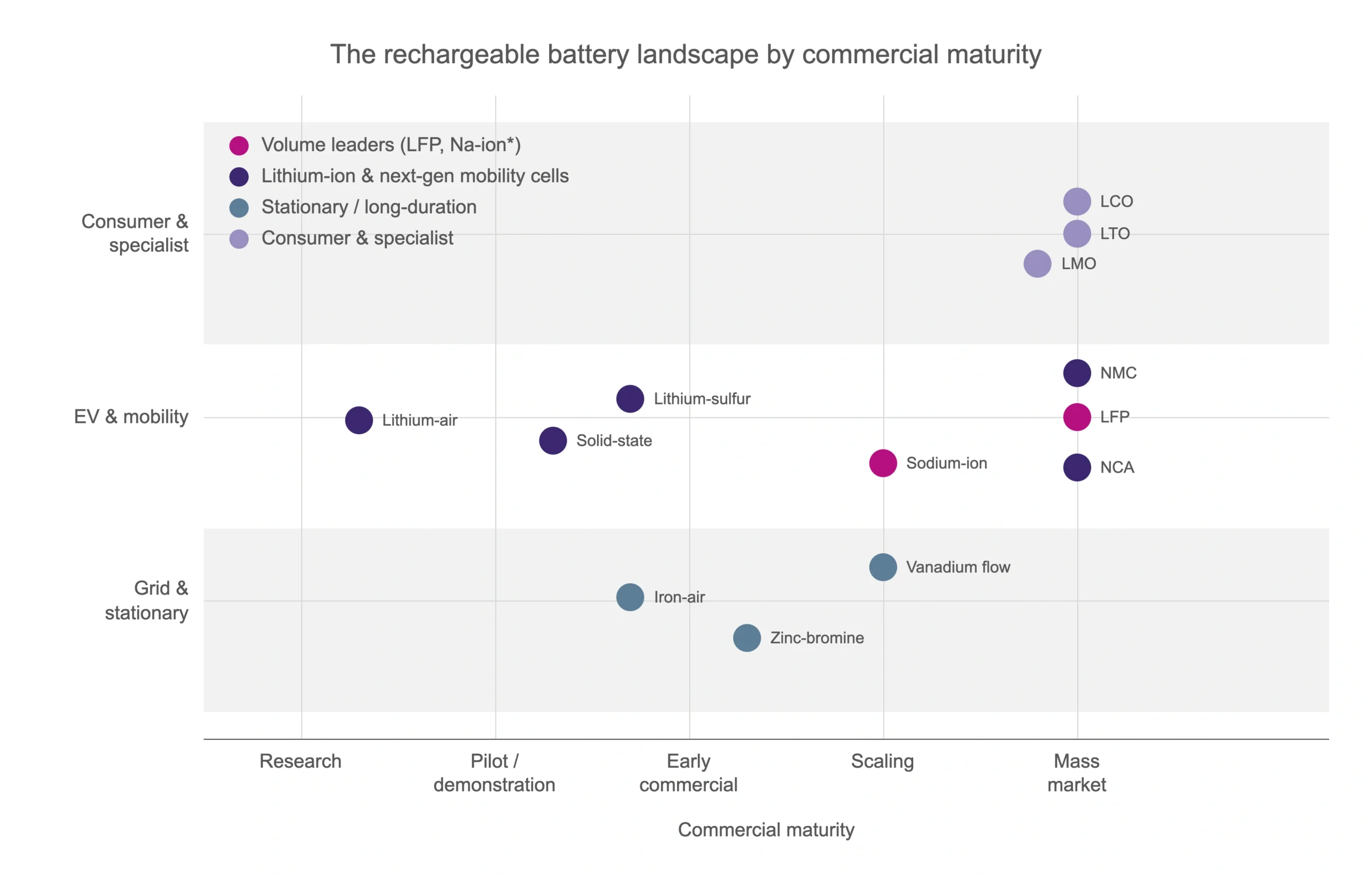
Figure 1: The rechargeable battery landscape by commercial maturity and primary application. LFP and sodium-ion (*) serve both EV and grid markets.
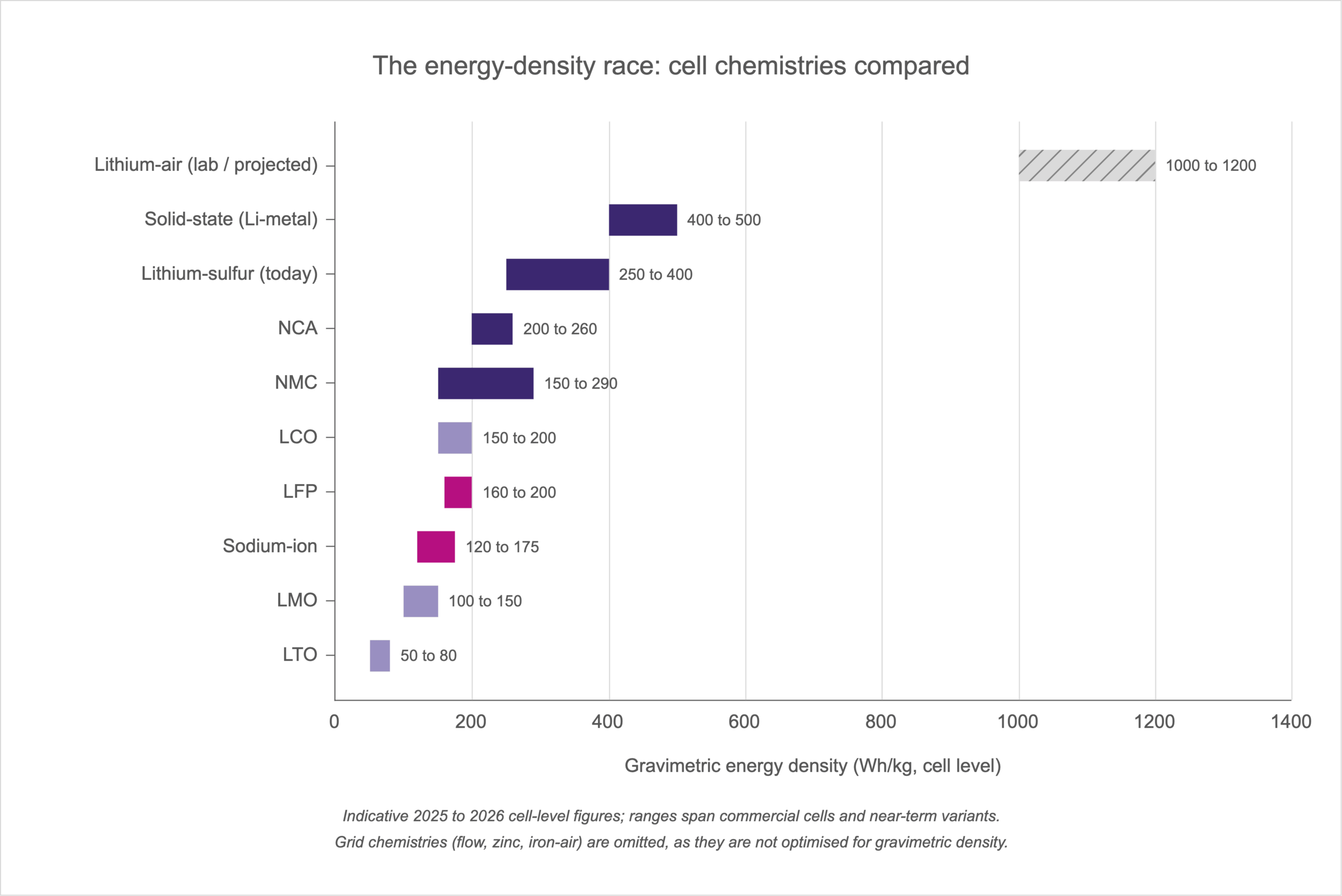
Figure 2: Gravimetric energy density (cell level) across the mobility-relevant chemistries. Lithium-air is a laboratory or projected figure; grid chemistries are omitted, as they are not optimised for density.
What it means
- There is no universal winner. Battery chemistry choice is application-specific: a trade-off between range, cost, cycle life, safety and duration. The right answer for a long-range car is likely the wrong one for a grid-scale storage plant.
- Lithium-ion is already plural. The LFP-versus-NMC split bifurcated the market years ago. Sodium-ion now adds a credible third mainstream option for cost-sensitive segments.
- The frontier is manufacturing, not materials. Solid-state and lithium-sulfur are gated by scale-up (yield, cost and cycle life at volume) rather than by unproven chemistry.
- Grid storage is diverging from EVs. Flow, zinc and iron-air chemistries answer a different question, duration and lifecycle cost, and sit largely outside the energy-density race that drives EV battery development.
- China leads commercialisation across most fronts, through CATL, BYD, HiNa and Rongke, with pockets of Japanese, Korean and US strength in Toyota, Samsung SDI, QuantumScape, Factorial, Lyten, Eos and Form Energy (see sources 9, 11, 15, 18, 19, 24, 26 and 28 below).
- Where are the patents? Our future companion article will map international patent activity across these battery chemistries, and ask whether the filing record tracks, or anticipates, the commercial picture set out here.
Note on figures. Energy density, cost, cycle-life and maturity figures are indicative, cell- or system-level values drawn from 2024 to 2026 industry and public-domain sources and are intended for comparison only. Emerging-chemistry figures reflect the best current claims and laboratory results and should be read as fast-moving. Sources are listed below.
Sources
1 Materials-processing insights (hard-carbon anodes for sodium-ion, aluminium current collectors, sulfur as a refining byproduct, silicon-anode energy targets): Xiao et al., “From Mining to Manufacturing: Scientific Challenges and Opportunities behind Battery Production”, Chemical Reviews (2025). Source: Xiao et al., Chemical Reviews (2025), doi:10.1021/acs.chemrev.4c00980
2 NMC/NCA manufacturers: Tycorun Energy, “NMC vs NCA Battery: Which One is Superior? (2026 Guide)”. Source: https://www.tycorunenergy.com/nmc-vs-nca-battery/
3 LFP thermal-runaway comparison: critical self-heating (the point of no return) at approximately 230 to 260°C for LFP versus approximately 170 to 190°C for NMC. Source: Battery Design, “NMC vs LFP Safety: What the Data Actually Shows” (24 February 2026)
4 Toshiba SCiB lithium-titanate technology, rapid charging, low-temperature operation and cycle life: Toshiba, SCiB rechargeable-battery catalogue. Source: https://www.global.toshiba/content/dam/toshiba/ww/products-solutions/battery/scib/pdf/ToshibaRechargeableBattery-en.pdf
5 LMFP (Gotion Astroinno): 240 Wh/kg gravimetric energy density, 525 Wh/L volumetric, 4,000 cycles at room temperature. Source: Gotion High-Tech / CleanTechnica, “Gotion Introduces LMFP Battery With Energy Density Of 240 Wh/Kg” (20 May 2023)
6 CATL M3P / Tesla validation and Chinese-market use: electrive, “Tesla validates LMFP cells from CATL already used by Chery” (29 February 2024). Source: https://www.electrive.com/2024/02/29/230105/
7 Manganese-rich cathodes (LMR): GM and LG Energy Solution lithium manganese-rich prismatic cells, ~33% higher energy density than LFP at comparable cost, US production targeted for 2028. Source: General Motors, “GM and LG Energy Solution to pioneer LMR battery cell technology” (13 May 2025)
8 Sodium-ion (CATL Naxtra): 175 Wh/kg cell energy density, 90% usable power at -40°C, over 10,000 cycles, mass production from 2025. Source: CATL, “Naxtra Battery Breakthrough & Dual-Power Architecture” (21 April 2025)
9 Sodium-ion (CATL Naxtra passenger vehicle): world’s first mass-production sodium-ion passenger vehicle, developed with Changan, market launch targeted mid-2026. Source: CATL, “CATL and CHANGAN Launch World’s First Mass-Production Sodium-Ion Passenger Vehicle” (5 February 2026)
10 Faradion / Reliance sodium-ion scale-up: NS Energy, “Reliance to acquire sodium-ion battery technology company Faradion” (3 January 2022). Source: https://www.nsenergybusiness.com/deals/reliance-faradion-sodium-ion-battery-technology-acquisition/
11 Solid-state (QuantumScape / Volkswagen PowerCo): A-sample cells exceeding 1,000 charging cycles with more than 95% capacity retention. Source: Volkswagen Group, “PowerCo confirms results: QuantumScape’s solid-state cell passes first endurance test”
12 Samsung SDI solid-state pilot line and 2027 mass-production plan: Samsung SDI, company battery overview and S-Line materials. Sources: https://www.samsungsdi.com/business/index.html; https://news.samsungsdi.com/global/press/view?seq=11
13 Solid Power / BMW all-solid-state collaboration and BMW i7 testing: BMW Group, “BMW Group and Solid Power are testing all-solid-state battery cells in a BMW i7” (20 May 2025). Source: https://www.press.bmwgroup.com/global/article/detail/T0450240EN/bmw-group-and-solid-power-are-testing-all-solid-state-battery-cells-in-a-bmw-i7
14 Solid-state commercialisation timing: Battery Technology, “Production Timelines for 14 Upcoming Solid-State Batteries” (23 January 2026), describing pilots/first commercialisation in 2027–2028 and mainstream mass production around 2030. Source: https://www.batterytechonline.com/market-analysis/production-timelines-for-14-upcoming-solid-state-batteries
15 Solid-state measured energy density and dendrite suppression: QuantumScape QSE-5 B-sample, 301 Wh/kg and 844 Wh/L (fully packaged cell), with a ceramic separator that stabilises the lithium-metal interface. Source: QuantumScape, “A First Look at the QSE-5 B Sample” (23 October 2024)
16 Solid-state manufacturing and the two US front-runners (QuantumScape ceramic route, Factorial polymer route), and a caution on overclaiming: Scientific American, “Can QuantumScape and Factorial Energy Mass-Produce Solid-State Batteries?” (18 August 2026)
17 QuantumScape manufacturing milestones: Cobra separator process into baseline production (2025) and inauguration of the Eagle Line pilot production line (4 February 2026). Source: QuantumScape, “QuantumScape Inaugurates Eagle Line for Solid-State Battery Pilot Production” (4 February 2026)
18 Factorial Energy FEST cells: 375 Wh/kg automotive-scale solid-state cells validated with Stellantis; subsequently tested by Mercedes-Benz and integrated into a Stellantis development vehicle for road testing. Source: Stellantis, “Stellantis and Factorial Energy Reach Key Milestone in Solid-State Battery Development” (24 April 2025)
19 Lithium-sulfur (Lyten): acquisition of former Northvolt manufacturing assets in Sweden, Germany and Poland, with commercial lithium-sulfur cells targeted for the second half of 2026. Source: Lyten, “Lyten Acquisition of Northvolt Assets”
20 Zeta Energy lithium-sulfur development: U.S. Department of Energy ARPA-E, Zeta Energy project page. Source: https://arpa-e.energy.gov/programs-and-initiatives/search-all-projects/enabling-fast-charging-batteries-3d-lithium-metal-architectures-and-sulfurized-carbon-cathodes
21 Lithium-air: an Argonne National Laboratory and Illinois Institute of Technology solid-electrolyte design achieved a four-electron reaction at room temperature over more than 1,000 cycles, with a projected record energy density of 1,200 Wh/kg (about four times lithium-ion). Source: US Department of Energy, Office of Science, “Innovative Lithium-Air Battery Design Poised to Increase Energy Storage” (4 June 2025)
22 CATL lithium-air roadmap and post-2030 horizon: Battery Design, “CATL and Lithium-Air” (9 June 2026). Source: https://www.batterydesign.net/catl-and-lithium-air/
23 Vanadium flow lifetime and cycle life: 20,000+ cycles and 25+ year calendar life. Sources: Earth Energy Log, “Vanadium flow batteries 2026: where VRFBs beat lithium” (25 April 2026); U.S. Department of Energy, “Technology Strategy Assessment – Flow Batteries”, Storage Innovations 2030 (2023)
24 Vanadium flow (Rongke Power): entry into operation of the 200 MW / 1,000 MWh Jimusar project in Xinjiang, the world’s first gigawatt-hour-scale vanadium redox flow battery, on 31 December 2025. Source: Energy-Storage.news / China Three Gorges, “World’s first gigawatt-hour-scale flow battery project goes into operation in China” (December 2025)
25 Invinity and Sumitomo Electric vanadium-flow activity: Invinity Energy Systems, vanadium-flow-battery overview; Sumitomo Electric, VRFB product overview. Sources: https://invinity.com/vanadium-flow-batteries/; https://sumitomoelectric.com/products/flow-batteries
26 Zinc-bromine (Eos Energy): federal loan guarantee for Eos’s Turtle Creek, Pennsylvania Z3 zinc-bromine manufacturing lines; discharge duration described by DOE as three to 12 hours. Sources: U.S. Department of Energy, Loan Programs Office, “EOS” project page; Utility Dive, “Eos Energy lands $400M DOE conditional loan guarantee for long-duration battery plant” (1 September 2023)
27 Iron-air round-trip efficiency: approximately 40 to 50% round-trip efficiency. Source: How To Store Electricity, “Iron-Air Battery 2026: 100-Hour Long-Duration Storage”
28 Iron-air (Form Energy): 100-hour duration iron-air batteries manufactured at Form Factory 1 in Weirton, West Virginia; $750 million Series G financing (August 2026) and a 30 GWh Google data-centre supply agreement. Source: TechCrunch, “Form Energy raises $750M to build more 100-hour batteries for the grid” (12 August 2026)
29 Graphite supply concentration: China mines roughly 75 to 82% of the world’s natural graphite and processes an estimated 85 to 95% of battery-grade (spherical) graphite. Sources: U.S. Energy Information Administration, “China dominates global trade of battery minerals” (21 May 2025); GlobalData, cited in Resources Review, “China dominates graphite supply, risking global chains” (29 July 2025)
30 Critical-material supply and export controls: China’s graphite dominance and the October 2025 export-control decision (subsequently suspended). Source: Herbert Smith Freehills Kramer, “China imposes export controls on lithium-batteries and artificial graphite anode materials” (10 October 2025); on the suspension: Herbert Smith Freehills Kramer, “China suspends export controls on lithium-batteries and artificial graphite anode materials” (18 November 2025)
31 Battery pack prices. BloombergNEF 2025 Lithium-Ion Battery Price Survey: average LFP packs at $81/kWh and NMC packs at $128/kWh; volume-weighted average $108/kWh. Source: BloombergNEF, “Lithium-Ion Battery Pack Prices Fall to $108 Per Kilowatt-Hour” (9 December 2025)
32 LMR cycle-life disclosure status: GM’s 13 May 2025 announcement gives production timing, cost and energy-density claims but no cycle-life figure; CarCody notes that final production cycle-life and retention figures had not been released as of 17 August 2026. Sources: https://news.gm.com/home.detail.html/Pages/news/us/en/2025/may/0513-GM-LG-Energy-Solution-pioneer-LMR-battery-cell-technology.html; https://carcody.com/gms-manganese-rich-battery-targets-cheaper-long-range-evs-from-2028/